The Case
Why Gas Lawn Equipment
Has to Go
The data is clear. Electric alternatives exist. The only thing missing is the political will.
Noise: Louder Than You Think
Gas-powered lawn equipment is dangerously loud — and most people don't realize how bad it is.
| Equipment | Decibels (operator) | Comparable To | Hearing Safe For |
|---|---|---|---|
| Gas Lawn Mower | 85–95 dB | Motorcycle at 25 ft | < 2 hours |
| Gas Leaf Blower | 90–105 dB | Rock concert | < 15 minutes |
| Gas String Trimmer | 90–100 dB | Jackhammer | < 30 minutes |
| Electric Lawn Mower | 65–75 dB | Normal conversation | 8+ hours |
| Electric Leaf Blower | 60–70 dB | Background music | Unlimited |
NIOSH recommends no more than 85 dB for 8 hours. Every 3 dB increase cuts the safe exposure time in half. At 95 dB, you have less than an hour. Professional landscapers — who are exposed for hours daily — face significant hearing loss risk that is entirely preventable.
Emissions: A Hidden Polluter
The two-stroke engines in most gas leaf blowers and trimmers are among the dirtiest combustion engines still in widespread use. They burn a mix of oil and gasoline incompletely, producing a toxic cocktail of:
- Carbon monoxide — a poisonous gas
- Nitrogen oxides (NOx) — smog-forming pollutants
- Particulate matter (PM2.5) — fine particles that lodge deep in lungs
- Volatile organic compounds (VOCs) — including benzene, a known carcinogen
- Unburned hydrocarbons — raw fuel vapor
1 hour
Running a gas leaf blower for one hour produces smog-forming emissions equal to driving a Toyota Camry for 1,100 miles.
Source: California Air Resources Board
The EPA estimates that gas-powered lawn equipment accounts for approximately 5% of total U.S. air pollution — and in some urban areas during peak lawn season, that share can climb much higher. Yet these engines face almost no federal emissions regulation comparable to the standards applied to cars and trucks.
Health Impacts Beyond Hearing
The combined effects of noise and air pollution from lawn equipment create a public health burden that falls disproportionately on certain populations:
- Night shift workers trying to sleep during daytime hours
- Infants and young children whose nap schedules are disrupted
- Remote workers unable to concentrate during business hours
- People with sensory sensitivities, PTSD, or anxiety disorders
- The elderly and those with cardiovascular conditions exacerbated by noise stress
- Low-income neighborhoods where lawn services may run equipment longer and more frequently
Studies have linked chronic noise exposure to increased rates of hypertension, heart disease, cognitive impairment in children, and sleep disturbance. The WHO estimates that Western Europeans lose over 1 million healthy life years annually due to traffic-related noise alone — and neighborhood equipment noise compounds this burden.
The Electric Alternative Is Here
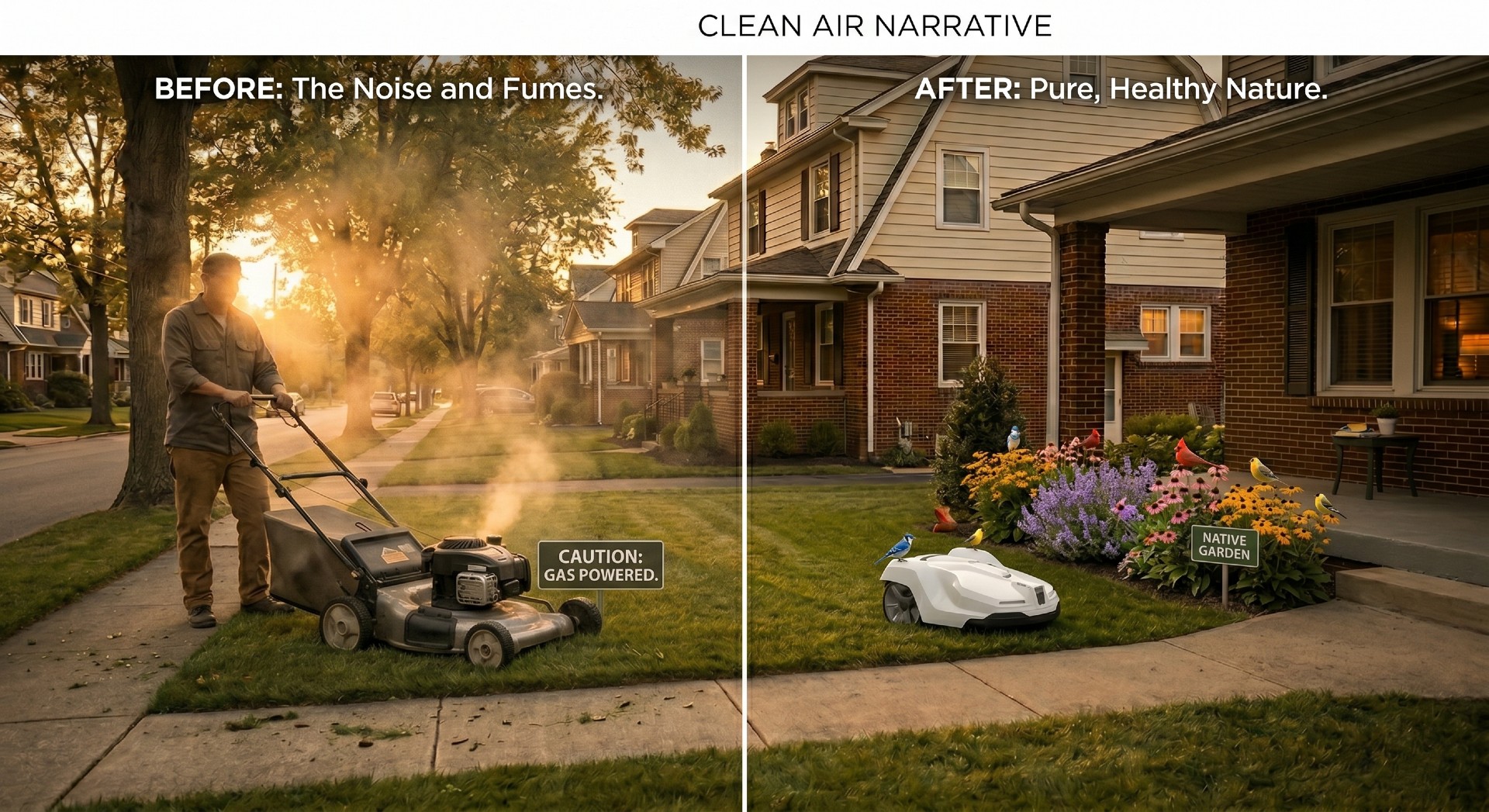
This is not a call to mow less. It's a call to mow differently. Electric lawn equipment has advanced dramatically in the last decade:
- Battery technology now delivers 45–90 minutes of runtime on a single charge — enough for most residential lawns
- Performance parity with gas for all but the most demanding commercial applications
- Lower total cost of ownership over 5 years when accounting for fuel, oil, spark plugs, and maintenance
- Instant start, no pull cord, no winterizing, no fuel storage
- A fraction of the noise — conversation at normal volume while mowing
Dozens of cities have already made the transition. The ordinance library documents them all. Every new win makes the next one easier.
The Bottom Line
The status quo is loud, dirty, unhealthy, and unnecessary. The technology to fix it exists. The ordinances to require it have already been written and passed elsewhere. The only question is whether enough people demand the change.
That's where you come in.